
The Chemistry of Comfort: Keep Your Jerseys Wicking and Jackets Repelling
 As a bike fitter, I use motion capture technology to help inform my fitting process and I rely on motion capture markers staying put. My current STT 3DMA system utilises 20 infra-red markers, allowing me to scan both sides of the body at the same time. This produces an incredible 3D moving image of the cyclist pedalling their bike.
These markers are applied to all the main points of articulation such as knees, elbows, ankles, hips and shoulders. A lot of the markers are applied directly to the cyclist’s jersey, shorts, or socks. Sometimes I have difficulty getting the markers to stick which can reduce the effectiveness of the motion capture and therefore its accuracy.
Before becoming a bike fitter, I completed a Chemistry degree (and afterwards worked in hazardous waste management disposing of chemical waste, a story for another day), and my final year dissertation was a project looking at using Sheep’s wool to remove oil from sand. It was topical at the time because of the Gulf war and the attacks on Kuwait oil fields. As a result of that project, I know exactly why some fabrics shrug off adhesives and others hold like Velcro—and why your household detergent might be quietly wrecking your expensive cycling kit. The tension (😉) here is simple: you paid for performance, but your washing routine is turning it off.
Why your kit’s performance disappears in the wash
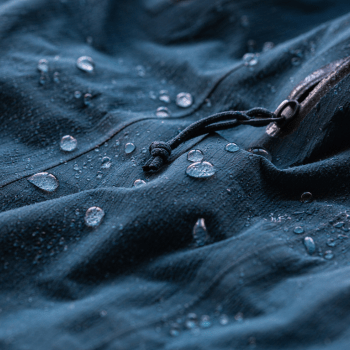 If you ride in Leicestershire weather, you know the drill: summer jerseys need to wick sweat and dry fast; winter jackets and tights need to shed rain and keep breathing. Fabrics are engineered for this. Laundry products are not—at least, not the usual “3‑in‑1 makes-everything-soft-and-perfumed” stuff. Here’s the chemistry in plain English:
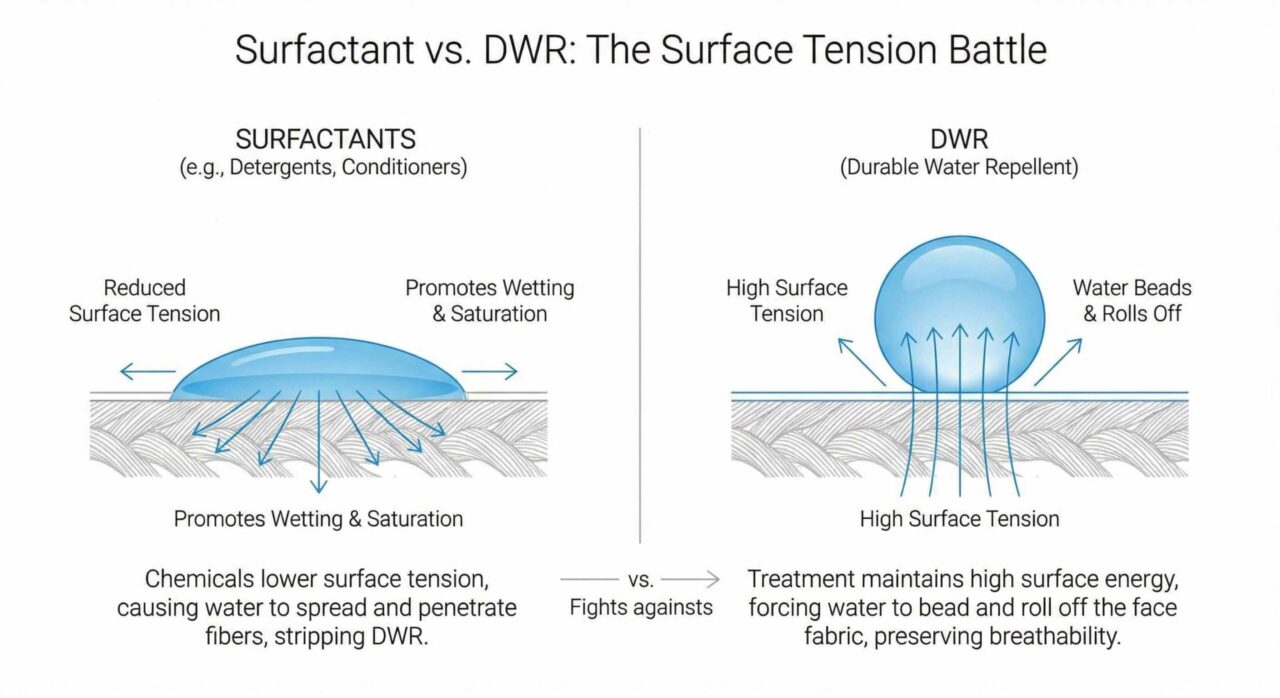
- Surfactants in general detergents reduce water’s surface tension so it can penetrate fabric and lift oils. Great for stains; terrible for Durable Water Repellent (DWR) coatings.
- DWR increases surface tension, making water bead and roll off. Surfactants coat and strip DWR, encouraging wetting-out.
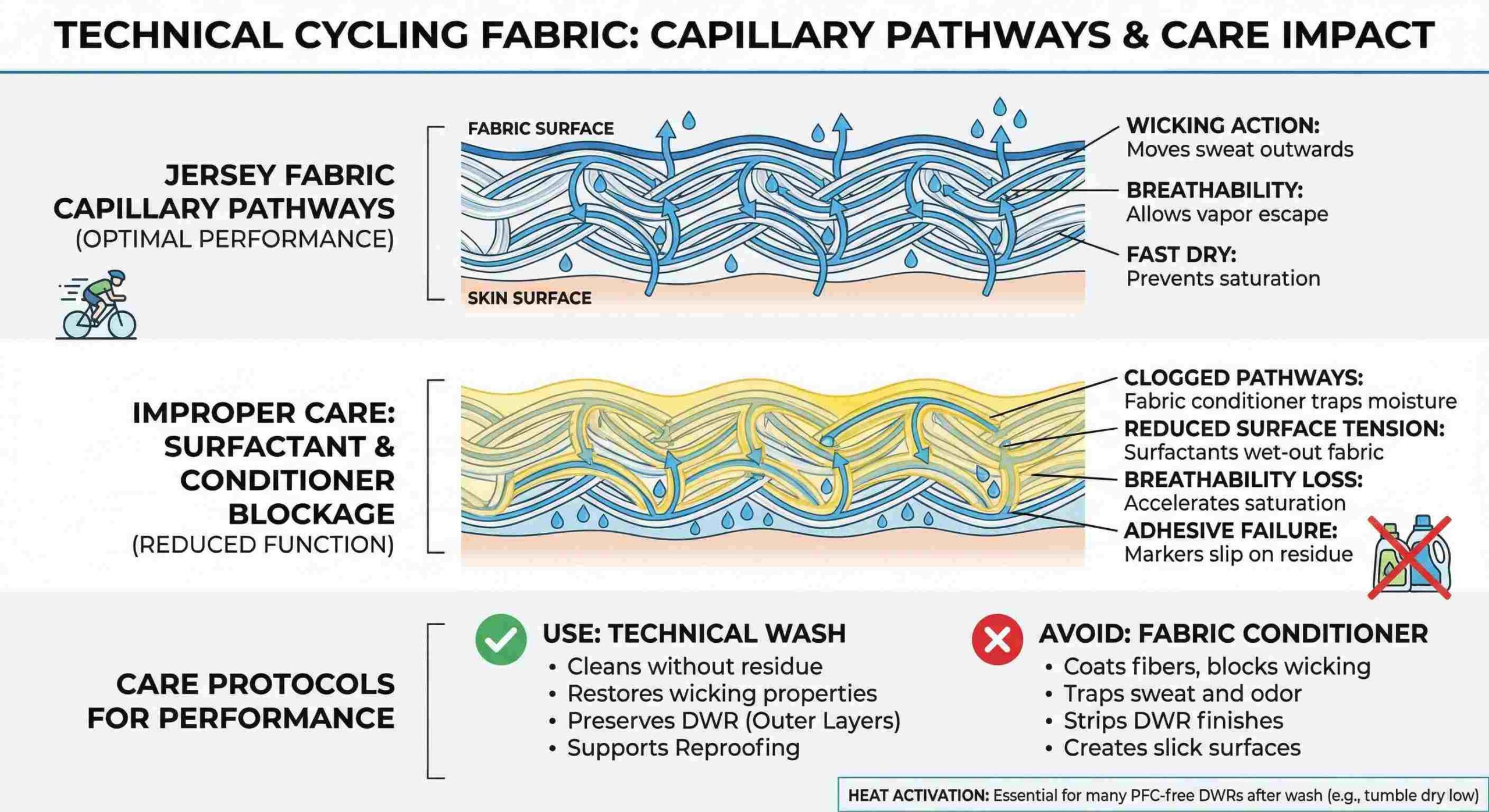
- Fabric conditioners add a soft, waxy film that blocks the tiny pathways moisture uses to move from your skin to the outside. Result: clammy, slow-drying kit and that “boil-in-a-bag” feeling. In short: your laundry detergent choice can undo your kit’s sweat-wicking and water-repelling superpowers.
Why it matters on the bike
- Comfort and warmth: Once an outer fabric wets out i.e. it becomes saturated, breathability tanks. Moisture can’t escape, condensation builds, and you feel damp—even if the membrane is technically waterproof. The water chills in the wind as you ride and you get cold.
- Hygiene and longevity: Tights and shorts with chamois pads need washing after every ride to prevent bacteria spreading and potential saddle sores occurring. The wrong washing product accelerates DWR loss, reduces breathability, turns them smelly faster, and shortens their lifespan.
- Fit data quality: For bike fitting, fabric properties affect how markers stick and how consistently we can track your angles under heat and sweat.
Summer vs. winter kit: different jobs, different care
Summer jerseys and shorts (base and mid-layers)
- Goal: fast sweat-wicking, quick drying, odour control.
- Reality: fabric conditioner gums up the works; generic detergent leaves surfactant residues that slow wicking and trap smells.
- Better plan: use a technical base/mid-layer wash designed to clean without clogging the fibres and to restore wicking efficiency.
Winter jackets and tights (outer layers with DWR)
- Goal: water-repellency outside, breathability from inside out.
- Reality: repeated abrasion (storing in rucksacks or jersey pockets, folds, sleeve rub) plus harsh detergents strip DWR, leading to wetting-out and cold rides.
- Better plan: use an apparel wash formulated to clean without attacking the original DWR—and prepare the fabric properly for reproofing when needed.
- Apparel Wash: cleans and helps sustain breathability and repellency without stripping original treatments. It works on cotton, synthetics, Gore‑Tex, eVent, etc. It’s the ideal prep before reproofing.
- Base & Mid-Layer Wash: restores wicking, tackles lingering odour, and keeps your base layers drying fast—whether it’s cycling kit or gym wear. Basically, anything that you wear to be active and sweat in.
- Merino & Wool Wash: pH-balanced for wool, maintains breathability and extends garment life. Merino stays warm even when wet and resists smells—this wash keeps those strengths intact.
- Apparel Proofer (PFC-free): restores water repellency after abrasion and repeated washing. Activate with gentle heat; be careful with temperatures on delicate fabrics.
- Jerseys and shorts: wash with a base/mid-layer formula, skip conditioner, and avoid mixing with heavy cottons that shed fluff/lint and clog fibres.
- Jackets and tights: use an apparel wash. When water stops beading, reproof and activate with low heat.
- Merino: go merino-specific and low-temp—wrong pH shortens its life and wrecks feel.
- Detergent economy: rinsing in water alone can remove light grime but won’t tackle oils or odours. If you’ve invested hundreds in kit, spend a few quid to clean it properly.
- Markers and fittings: better-managed fabrics mean fewer dropped markers and cleaner data during your fit.
- Ditch fabric conditioner for all technical kit.
- Separate base/mid-layers from outer layers; use the right wash for each.
- Wash cool, minimal spin; avoid overloading—water and wash need space to work.
- Reproof outer layers when beading fades; heat-activate per label.
- Store jackets loosely (not crumpled) to reduce abrasion; avoid stuffing in a rucksack wet.
- For merino, use wool-specific wash and air dry.
- If you’ve used standard detergent, run a technical wash cycle to remove surfactant buildup.
A quick sidebar: PFAS, PFCs and why reproofing changed
Perfluorinated compounds (PFCs/PFAS) made amazing repellents—think Teflon-level non-stick. Their chemistry is incredibly stable, which is exactly why they accumulate and don’t break down in the environment or our bodies. They’re being phased out or banned, and modern proofers are PFC-free. They’re kinder to the planet, but they require more regular care and proper activation (usually low heat via tumble drying, ironing with care, or warm air on a radiator).
Storm Care: sustainable chemistry for technical fabrics
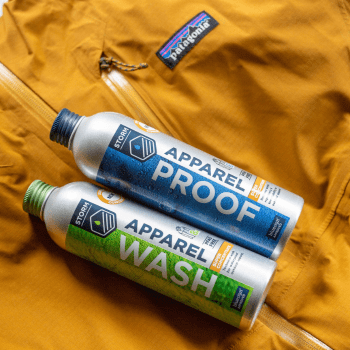
I bumped into Tobias Yoh, Storm Care’s marketing manager, at Madison’s IceBike trade show in February and fell straight back into my Chemistry-geek rabbit hole. Storm Care have created a product range that is formulated to preserve performance without the environmental baggage:
Slightly digressing from my blog on fabric care but an obvious extension of their chemistry expertise, Storm Care also produce an Anti-fog spray, handy for cycling glasses and visors to keep vision clear in drizzle or on sweaty climbs.
Having had the chemistry and environment nerd gene reactivated whilst researching the above, I decided to read up a bit on Storm Care’s website about their environmental credentials. Storm also package their products using recycled aluminium, which has a high recovery rate compared to plastics. Nice touch from a company founded in 2002 with “sustainable chemistry” baked in. I’d probably be going too far and boring people by wondering about their ISO accreditations, and bunding and drainage systems in their liquid storage areas! It was, as I say, “in another life“.
What “wetting out” actually means
When the outer fabric absorbs water instead of beading it off, it saturates. Breathability collapses, sweat can’t escape, and moisture condenses inside. You feel damp or sweaty even with a waterproof membrane—classic boil-in-a-bag. That’s your sign that DWR needs help: deep clean with a technical apparel wash, then reproof and heat-activate.
Practical implications for your kit
Actionable steps: how to wash for performance
A note on adhesives and markers
If you’ve ever apologised when a marker drops off mid-fit, it’s not you—it’s the fabric. High-wicking, conditioner-coated, or surfactant-laden surfaces shed adhesives faster when warm. Good garment care improves the odds. And if you’re in for a fit, I’ve got backup methods that keep the session on track.
Want help dialing in your comfort?
If your kit is fighting you, your bike might be too. A proper fit and a well-cared-for wardrobe work together. Book a Bike Fit or read more about comfort on longer rides—and give your laundry a promotion from “generic” to “technical.”
Performance fabrics aren’t divas; they’re just finely tuned. Treat them right and they’ll wick, breathe, and bead on cue—making your rides warmer (or cooler), drier, and a lot less sticky. The next time rain beads off your sleeve and you feel air moving through your layers, you’ll know: that wasn’t luck. That was chemistry.